Best Closet Organizers for Small Bedrooms
A small bedroom closet is one of the hardest storage spaces in a home. It has to hold clothes for every season, shoes, accessories, and often bedding or off-season items too — in a space that was designed when wardrobes were smaller and lifestyles were simpler. When it fails, the whole bedroom feels cluttered: clothes migrate to chairs, the floor, and the bed, and getting dressed becomes a daily excavation.
The good news is that most small closets are not actually full. They are badly used. A standard closet has a single rod and one high shelf, which wastes the vertical space below the hanging clothes, the floor space underneath, and the back of the door. The right organizers reclaim those wasted zones, and the difference can feel like gaining a second closet.
This guide covers the closet organizer types that work best in small bedrooms, how to plan around your actual wardrobe, and how to keep the closet working after the first tidy-up.
As an Amazon Associate, NestoraGuide earns from qualifying purchases. This article contains affiliate links. We do not claim Amazon Associates approval — our account is still in its qualification period — and we only recommend product types we believe solve a real problem. Any specific product named here was verified for its features before publishing; price and availability were not verified and should be checked on the live Amazon page before ordering. Read our Affiliate Disclosure
The Problem: Why Small Closets Overflow
Walk into a typical small-bedroom closet and you will see the same pattern: one rod, crammed with hangers so tightly that clothes cannot slide; a shelf above it piled with folded items that topple whenever one is pulled out; and a floor covered in shoes, bags, and things that never found a home.
The fix is not a bigger closet. It is a closet where every zone has a job: hanging for the things that wrinkle, folding for the things that do not, and dedicated storage for shoes, accessories, and seasonal items.
Start With Your Wardrobe, Not With Products
Before buying anything, take stock of what you own. This is the step most people skip, and it is the reason organizers get returned.
- Count by category. Roughly how many hanging items (shirts, dresses, jackets) versus folded items (t-shirts, knitwear, jeans) do you have? If most of your clothes can be folded, you need shelves and drawers more than rods.
- Measure the closet. Width, depth, and height, plus the height from the rod to the floor and from the shelf to the ceiling. Note the door type — sliding doors limit access to the sides, while a hinged door can hold a rack.
- Identify the dead zones. The space above the top shelf, below hanging clothes, and on the floor are usually underused. Those are the zones organizers should target.
- Be honest about what you wear. Clothes you have not worn in a year are not closet contents — they are storage. Moving them out (donation, off-season storage elsewhere) frees more space than any organizer.
A useful rule: a closet should be about 80 percent full. At 100 percent, nothing slides, nothing folds neatly, and the system collapses within a week.
The Best Types of Closet Organizers for Small Bedrooms
1. Hanging Shelves
Hanging shelves are fabric or rigid shelves that hook over the closet rod, creating instant cubbies for folded clothes, bags, or accessories. They are the fastest way to add storage to a closet with no built-in shelving, and they cost very little.
They work best for items that fold well — t-shirts, knitwear, jeans, and handbags. They are less good for heavy items, which can make fabric shelves sag, so look for sturdy construction and a rigid base if you plan to load them. In a shared closet, one hanging shelf unit per person keeps categories separate.
Best for: folded clothes, bags, and accessories in closets with no shelves.
2. Double Hang Rods
A second rod hung below the main one instantly doubles hanging space for short items — shirts, blouses, folded trousers, and jackets. It is one of the highest-impact changes you can make to a small closet, and it requires no drilling in many designs, since the second rod simply hooks onto the first.
The trade-off is the floor space below: a double rod leaves less room for shoes and storage underneath, so it works best when shoes live elsewhere or on a low rack. Measure the drop carefully — shirts need roughly 40 inches of hanging length, so the second rod only works if your closet is tall enough for two tiers.
Best for: wardrobes heavy on shirts, blouses, and short jackets.
3. Drawer Dividers and Closet Drawers
Drawers fail without dividers. A single open drawer becomes a jumble within days, while the same drawer divided into sections keeps socks, underwear, and accessories in their own lanes. Dividers work in built-in drawers, freestanding drawer units, and even in open bins.
If your closet has no drawers at all, a small stackable drawer unit placed on the closet floor can hold the small items that otherwise scatter — underwear, socks, belts, and accessories. Choose a unit that fits the width of your closet and leaves room for the door to close.
Best for: socks, underwear, accessories, and anything small that disappears in an open drawer.
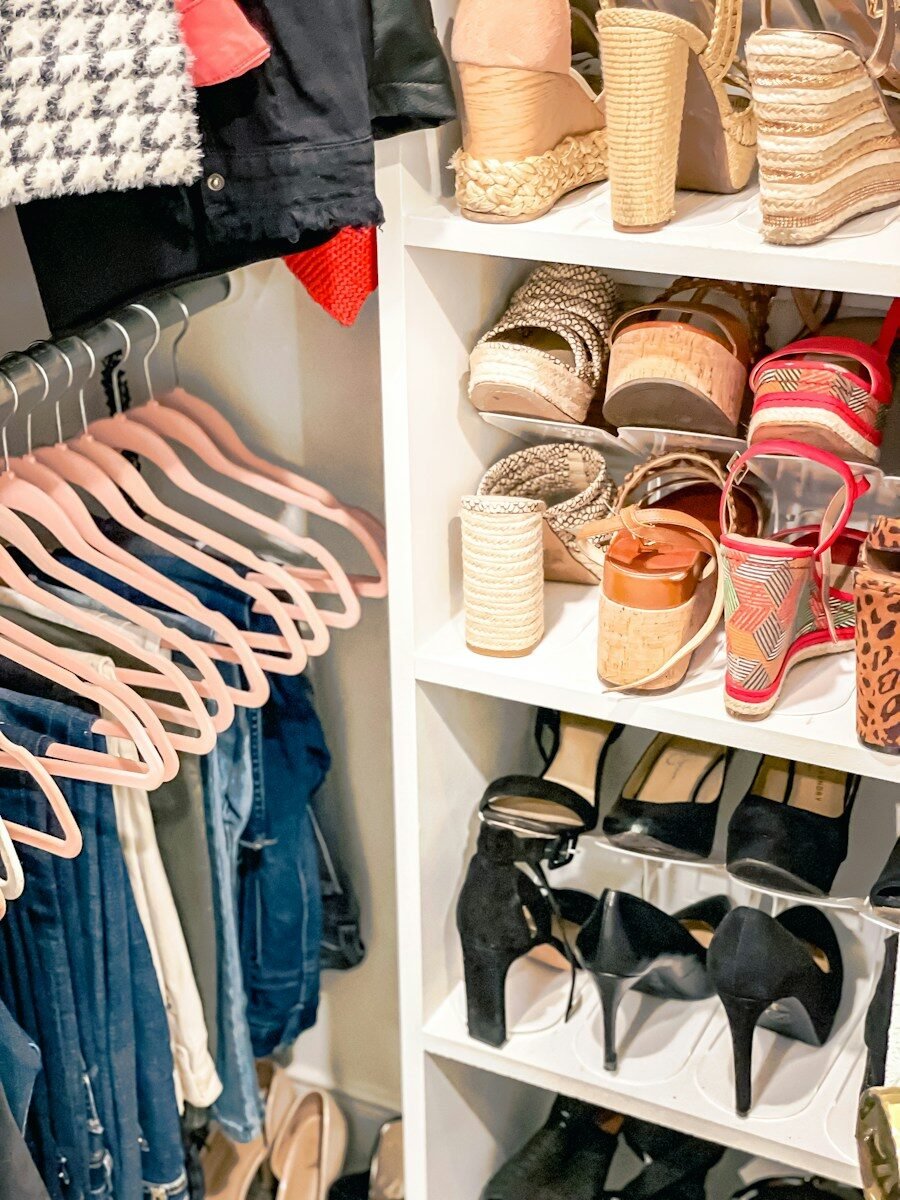
4. Shoe Organizers
Shoes are the classic closet-floor problem. Left loose, they spread, collect dust, and make the whole closet feel untidy. The right shoe storage depends on how many pairs you own and how much floor space you have.
A low shoe rack keeps pairs visible and off the floor. An over-the-door shoe organizer uses vertical space and works well for flat shoes and sandals. Clear shoe boxes stack neatly and protect shoes from dust, but they take more time to access — best for pairs you wear less often. The honest answer for most small bedrooms is a mix: a rack for everyday pairs, and boxes or an over-door organizer for the rest.
Best for: keeping everyday shoes visible and seasonal pairs protected.
5. Storage Bins and Boxes
Bins are the closet’s general-purpose tool. Labeled bins on the top shelf hold off-season clothes, accessories, and bedding without the pile-topple problem of loose folding. Clear bins let you see what is inside; fabric bins look softer and suit a bedroom better. Either works — the label is what matters most.
Use bins for categories, not for random overflow. One bin for scarves, one for swimwear, one for off-season knitwear. When a bin becomes a junk drawer, the system has failed — empty it, sort it, and start again.
Best for: off-season clothes, accessories, and top-shelf storage.
6. Under-Bed Storage
When the closet is genuinely full, the space under the bed is the bedroom’s best overflow. Low, flat storage boxes or bags under the bed hold off-season clothes, spare bedding, and shoes without taking any closet space at all. This is especially useful in small bedrooms, where the closet was never designed to hold a full modern wardrobe.
Choose containers that slide easily and keep dust out, and label them. Under-bed storage fails when you forget what is under there, so a quick inventory list taped inside the closet door helps.
Best for: off-season clothes, spare bedding, and shoes in small bedrooms.
7. Multi-Tier Space-Saving Hangers
A multi-tier hanger holds several pairs of trousers, jeans, scarves or leggings on a single hook, so one hanger does the work of five. It is the cheapest way to free rod space in a crowded closet, and it works best for the items that otherwise pile up on a chair: trousers, jeans and scarves.
Featured product: MORALVE Pants Hangers Space Saving, 2 Pack European Beechwood
The MORALVE is a 2-pack of European beechwood hangers with a 5-tier design, a 360° swivel hook, and a non-slip coating. The swivel hook makes loading and unloading easy — you turn the hanger to reach a layer instead of pulling items off over each other — and the non-slip coating keeps clothes from sliding off the tiers. One hanger holds trousers, jeans, skirts, scarves or leggings, so a pair of them can clear a surprising amount of rod space.
Why it fits here: it solves the crowded-rod problem directly, without installation and without taking any shelf or floor space — exactly what a small bedroom closet needs.
Check before you buy: make sure the 5-tier depth clears your closet rod and the clothes hanging beside it, and keep beechwood hangers in a dry closet.
Check Price on Amazon — As an Amazon Associate, NestoraGuide earns from qualifying purchases. Price and availability were not verified at the time of writing; check the live Amazon page before ordering.
Closet Organizer Comparison at a Glance
| Organizer type | Best for | Main benefit | Main limitation |
|---|---|---|---|
| Hanging shelves | Folded clothes, bags | Instant shelves, no installation | Can sag under heavy loads |
| Double hang rod | Shirts, short items | Doubles hanging space | Reduces floor space below |
| Drawer dividers | Small items, accessories | Stops drawer chaos | Must fit drawer exactly |
| Shoe organizers | Shoes | Visible, off the floor | Capacity tempts over-keeping |
| Storage bins | Off-season, top shelf | Categories stay separated | Large bins get heavy |
| Slim hangers | Crowded rods | Frees rod space cheaply | Not for heavy coats |
| Under-bed storage | Overflow, seasonal | Uses wasted space | Easy to forget contents |
Buying Advice: What to Check Before You Order
- Measure twice. Closet organizers are sized in inches that matter. A hanging shelf an inch too wide will not fit, and a drawer unit an inch too deep will block the door.
- Match the organizer to the clothes. A wardrobe of dresses needs hanging space; a wardrobe of knitwear needs shelves. Buy for the clothes you actually own.
- Think about access. The items you wear weekly should be at eye level and easy to reach. Seasonal items can live high up or under the bed.
- Durability matters more than looks. A closet organizer gets used every day. Fabric should feel sturdy, rods should hold weight without bowing, and zippers and hooks should operate smoothly.
For more ideas in the same room, browse Closet & Bedroom Organization, including Closet Organizers, Wardrobe Organizers, Shoe Storage, Storage Bins, Drawer Dividers, and Under Bed Storage.
Frequently Asked Questions
What is the best way to store off-season clothes?
Clean them first, then store them in labeled, dust-proof containers — on the top shelf if they are light, or under the bed if they are bulky. Vacuum-sealed bags save space but can crease delicate fabrics, so use them for bulky items like winter coats and spare bedding rather than fine knitwear.
How do I stop my closet from getting messy again?
Give every category a fixed home and make putting things away as easy as taking them out. A closet fails when returning clothes takes more effort than dropping them on a chair. A weekly two-minute reset — rehang strays, refold the toppled pile — keeps small messes from becoming a full reorganization project.
Conclusion
A small bedroom closet works when every zone has a job: hanging space for the clothes that wrinkle, shelves and cubbies for the clothes that fold, dividers for the small things, racks for shoes, and under-bed storage for the overflow. Slim hangers and a second rod can transform a crowded rod; labeled bins can tame a chaotic top shelf.
Start by measuring, remove what you do not wear, and organize one zone at a time. A closet that is 80 percent full and fully visible beats a closet that is 100 percent full and impossible to use — and getting dressed in the morning gets noticeably easier when you can actually see what you own.
Organize Beautifully. Live Better.